Timesheets missing hours again? This checklist shows what to test in employee timesheet software before you buy: from capture and approvals to reporting and compliance.
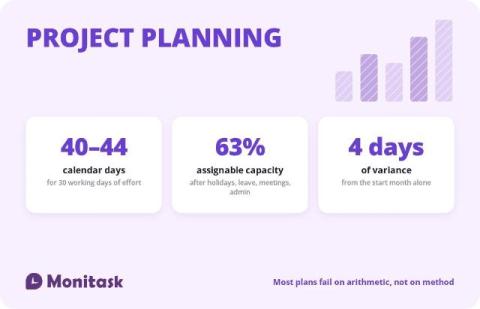
Every guide to project planning describes the same sequence: define objectives, identify stakeholders, build a work breakdown structure, estimate, schedule, add a risk register. That sequence is correct and it is not where projects go wrong. Projects go wrong in the conversion between effort and time. A team agrees a piece of work is 30 days of effort, someone writes “six weeks” in the plan, and the project lands late without anyone doing anything wrong.
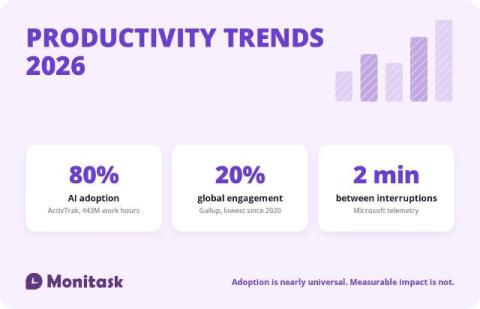
The defining productivity story of 2026 is not that AI arrived. It is that AI arrived almost everywhere and the results have not shown up on the balance sheet. Adoption is close to universal. Behavioural data from ActivTrak covering 443 million work hours across 1,111 companies puts AI adoption at 80%. Yet a National Bureau of Economic Research survey of roughly 6,000 executives found that between 89% and 95% of firms saw no measurable impact on productivity or employment over the preceding three years.
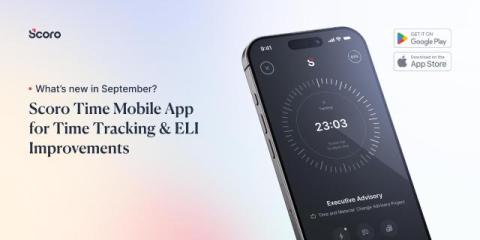
Your desktop is no longer the only place to log time – you can now do it straight from your phone with the new Scoro Time mobile app. We’ve also grown ELI’s capabilities – put ELI to work reading files, filtering list views for you, and running automations for you when certain trigger conditions are met. And that’s not it – there’s a lot more below!
Open source collaboration software gives organizations more control over how teams communicate, share files, manage projects, and work together. However, the category covers a wide range of tools, and the right choice depends on what your teams need to accomplish and how much control your organization needs over its data and security. In this guide, we’ll explain the main types of open source collaboration software, the features to look for, and the best tools for different collaboration needs.
Provider credentialing involves multiple teams, and even a small gap in communication can delay a provider’s readiness to practice and bill. HR may consider onboarding complete while credentialing has finished its review, yet payer enrollment may still be waiting on a health plan and Billing may not have a confirmed effective date. The challenge is rarely a lack of communication.
What context really means for agents, why models aren’t enough, and how to engineer context your teams can trust. Over the coming weeks we’ll be sharing more about context in this content series — including how to engineer context as a product, what a context graph actually is, and what it takes to build one that agents can trust. You can also learn more about how Atlassian is harnessing context in our latest report, Leading with Context.
Calls to Miro's MCP server surge past 16 million; MCP jumps the developer niche with individuals in non-engineering roles now among the majority embracing the technology.
Best workforce management software helps businesses schedule shifts, track time and attendance, and understand how work hours are used. Some platforms also include HR and payroll, while others focus on scheduling, time tracking, activity monitoring, or workforce analytics. This article compares 8 platforms which are Flowace, UKG Ready, Paycor (a Paychex company), BambooHR, Deel HR, Connecteam, Hubstaff, and ActivTrak. Pricing was last checked on September 29, 2026. TL;DR.
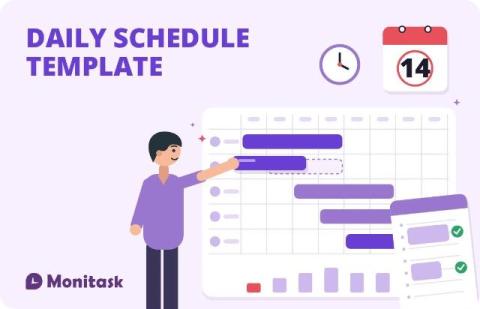
A daily schedule template does one of two things depending on who is using it. A manager uses it to put the right number of people on shift at the right hours. An individual uses it to block out a day by the hour. The template below covers both, in one Excel file. The manager version totals hours, calculates shift cost, and shows how many people are on shift during each hour of the day, which is the number most schedule templates never surface.