

















San Francisco, CA, USA
2011
  |  By Jeff Chow
If agents write the evals, draft the specs, and run the loops, what work is left for a product manager? One answer I keep seeing online is that product writes the evals, approves the agents, orchestrates the loops, and picks one at the end. At ProductCon San Francisco, I made the case that product’s role is much bigger: deciding what’s worth building and bringing a team along, which is especially important as agents accelerate building.
  |  By Emilia Jankowska-Zimolag
In September, our community published around 100 new templates: stakeholder maps and OKR trackers sat alongside accessibility checklists, strategic roadmaps, and a wave of templates landing in Spanish, Portuguese, and French. The throughline for the month was AI finding its way into everyday workflows – Miro Flows and Sidekick-powered boards built for use case ideation, risk brainstorming, and keeping AI-assisted projects on track.
  |  By Chris Jones
Most governance policies were written for defined records, such as a signed document, a sent email, or a file with one author and one date. That type of work still exists, but it now also takes place in team chats, AI conversations, and across canvases.
  |  By The Miro Team
Debbie Levitt, CXO of Delta CX, refused to bring AI into her work for a long time. Three years ago she tested the tools, found they couldn’t think critically or get basic facts right, and kept them out of her process. A year later, despite her initial disappointment, she decided to run an experiment based on her real work, and was amazed by the results.
  |  By Candace Cunningham
AI agents have made more than 19 million tool calls to Miro’s MCP server since February 2026, and the users behind them span product, design, marketing, operations, and project management. When we launched Miro’s MCP server in February, we had AI coding tools in mind.
  |  By The Miro Team
Josh Guice, Field CTO at Liatrio, says he can usually tell within the first few conversations whether a client’s AI rollout is actually working. Two or three people are quietly doing something impressive with it. Everyone else is stuck, spending more time wrestling with the tools than they used to spend on the work those tools were supposed to replace. He compares it to dropping a new graphics card into an old motherboard. The card itself is fine.
  |  By The Miro Team
Individual AI adoption has outpaced our ability to redesign how teams actually work together. The numbers back it up. In Forrester’s “The Visual Era of Collaborative Intelligence”, 89% of leaders say improving collaboration is key to hitting their organization’s goals – yet 75% agree most AI tools are built for individual, not team productivity, and 39% say that individual-first bias is actively hurting their AI ROI.
  |  By Miro
Calls to Miro's MCP server surge past 16 million; MCP jumps the developer niche with individuals in non-engineering roles now among the majority embracing the technology.
  |  By Christy Kirby
Pick an animal. Now pick the strengths you bring to your work. Combine the two, and you’ve built yourself a superhero. That was the warm-up exercise H&M Group used to open an AI Learning Day for its tech teams, and it set the tone for everything that followed: you come to the table with your superpowers, and AI handles the mundane.
  |  By Andrey Khusid
This morning I shared with the Miro team that we’ve signed a definitive agreement to join Bending Spoons. What I said to them is what I’d say to anyone who has followed this company over the past fifteen years, so I’m publishing the note here with only the internal logistics removed. You can also read more about the details of the agreement in our press release. Team, I have big news to share: Today, we signed a definitive agreement for Miro to be acquired by Bending Spoons.
  |  By Miro
Designers and UX pros spend too much time synthesizing research and mapping flows manually. In this video, we cover four AI-powered time-savers built for design workflows: summarizing user research instantly, turning insights into a structured repository with Miro Tables, visualizing user flows without drawing a single shape, and automating the entire research-to-direction process with Flows. From discovery to design direction. Without the busywork.
  |  By Miro
That place where company strategy decks go after everyone has finished presenting them? Martin Szugat calls it the “SharePoint graveyard.” As the founder of Datentreiber, a data and AI consultancy, Martin wanted to make strategy useful long after the presentation. So he built a workflow in Miro that takes a company strategy deck, extracts its objectives and key results, and turns them into prioritization criteria stakeholders can vote on.
  |  By Miro
Miro AI is more than a chatbot. It lives directly on your canvas and can generate Flows, Sidekicks, Prototypes, Docs, Diagrams, Sticky Notes, Tables, Images, and Mind Maps from simple prompts. In this video, we walk through every Miro AI capability so you know exactly what to reach for and when, whether you are running a sprint planning session, turning customer interviews into briefs, or generating an interactive prototype from a sticky note.
  |  By Miro
Most "AI transformation" conversations stop at strategy. The harder problem is what actually changes in how a team works day to day. In this episode of Miro Reframe, Josh Guice — Principal Architect at Liatrio — shares a year of real field notes from AI enablement engagements: watching product managers shape ideas before engineering ever sees them, replacing slide-deck training with pairing and teach-back, and learning that no workflow sticks unless the team structure around it changes too.
  |  By Miro
Leandro Barreto didn't set out to build a company. He set out to help his son. As a solo founder, Leandro built Epilog, an epilepsy tracking app, almost entirely with Miro as his AI product copilot. He started with sticky notes and a rough idea on a Miro board, then connected Miro MCP directly to his IDE so his AI coding assistant could pull the data model straight off the board. From there, the same AI reviewed the architecture like a solution architect, caught duplicated data and missing entities, and turned the fixes into a 22-item project roadmap.
  |  By Miro
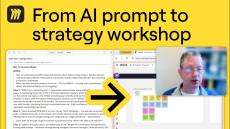
David Balkind runs strategy workshops without booking a room full of people. As a Specialist Innovation Advisor, David built what he calls a Strategy Café Engine — a setup where Claude, connected directly to his Miro board through MCP, runs full multi-session strategy workshops. Claude plays the facilitator (David calls it MOIRA), works through a structured innovation canvas box by box, and models different stakeholder perspectives — founder, funder, customer — to pressure-test the strategy from every angle. David checks in at key checkpoints while the canvas builds itself live on the board.
  |  By Miro
Wireframing from scratch is the slow way. In this video, we walk through the PRD to Prototypes template in Miro, showing you how to paste your product requirements document, add an optional style reference, and let Miro AI generate a fully clickable mobile prototype in minutes. We also show you how to extend it into a desktop version and iterate until you have exactly what you need. From requirements to interactive prototype without the hours of manual layout work.
  |  By Miro
@cyberjasbytes turns early thinking into briefs, prototypes, and diagrams the whole team can respond to.
  |  By Miro
Inefficient product workflows slow down delivery, create confusion, and waste resources. In this video, we walk through four Miro templates that help product managers identify bottlenecks with Value Stream Mapping, structure development phases from discovery to deployment, streamline feature prioritization with Epic and Feature Roadmap Planning, and measure workflow improvements over time. Less friction. Faster delivery. More predictable outcomes.
  |  By Miro
In this episode of How We Work, host Dominik Katz sits down with Josh Morales from Miro to talk about how UX research actually happens inside a fast-moving product team. Recorded live at UXDX, the conversation goes behind the scenes on building a research practice, partnering closely with product and design, and the habits that help research findings truly shape decisions. Whether you're a UX researcher, product manager, or designer curious about how Miro approaches user research, this episode offers a candid look at the people and processes behind the product.

Miro is the ultimate hub for your team or company where you can collaborate, visualize and collect ideas and share work. It can be a focal point for your offline meetings, or an endless workspace for distributed collaboration. Miro is your company-wide normalization layer for notes, media, data and other inputs — all from different sources and in different formats.

All of you — managers, designers, developers, coaches, marketers and other talented professionals — work together to build great things. Team members are all different and speak many "languages" — data, pictures, spreadsheets, tasks, charts and more. Miro combines all these pieces in one place to let your team or whole organization collaborate beyond formats, tools, locations and timezones.

Collaborate as a Dream Team:

  • Real-time collaboration: Fast and responsive — as close and engaging as it can get to in-person collaboration for teams working in a remote setting.
  • Infinite workspace: It’s critical for seeing the big picture. Our whiteboard is endless, yet zoomable and easy to structure.
  • Enhanced whiteboard toolkit: We digitized everything you like about working with a physical whiteboard.And more!

Miro is the #1 online whiteboard trusted by over 2 million users from global companies big and small.