


Teams | Collaboration | Customer Service | Project Management

The smallest team that can actually do the work

Josh Guice, Field CTO at Liatrio, says he can usually tell within the first few conversations whether a client’s AI rollout is actually working. Two or three people are quietly doing something impressive with it. Everyone else is stuck, spending more time wrestling with the tools than they used to spend on the work those tools were supposed to replace. He compares it to dropping a new graphics card into an old motherboard. The card itself is fine.
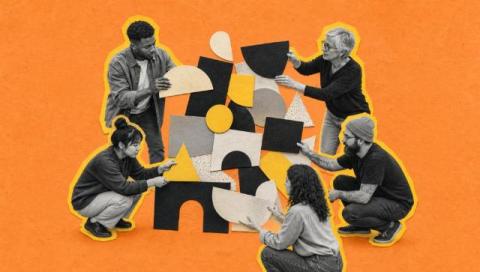

AI sharpens the individual. Does it dull the room?

Individual AI adoption has outpaced our ability to redesign how teams actually work together. The numbers back it up. In Forrester’s “The Visual Era of Collaborative Intelligence”, 89% of leaders say improving collaboration is key to hitting their organization’s goals – yet 75% agree most AI tools are built for individual, not team productivity, and 39% say that individual-first bias is actively hurting their AI ROI.

Amplify the person, automate the mundane: How H&M Group is building AI confidence across teams

Pick an animal. Now pick the strengths you bring to your work. Combine the two, and you’ve built yourself a superhero. That was the warm-up exercise H&M Group used to open an AI Learning Day for its tech teams, and it set the tone for everything that followed: you come to the table with your superpowers, and AI handles the mundane.

Miro + Bending Spoons: Building for the Long Term

This morning I shared with the Miro team that we’ve signed a definitive agreement to join Bending Spoons. What I said to them is what I’d say to anyone who has followed this company over the past fifteen years, so I’m publishing the note here with only the internal logistics removed. You can also read more about the details of the agreement in our press release. Team, I have big news to share: Today, we signed a definitive agreement for Miro to be acquired by Bending Spoons.

New Templates in Miroverse: August 2026

In August 2026, our community published 227 new templates to Miroverse. This month’s drop spanned everything from retros and workshop canvases to SWOT and gap-analysis frameworks, with templates arriving in German, French, Portuguese, and Spanish, alongside a steady wave of English submissions. AI kept showing up throughout the month too, with several creators building out Miro Flows-powered boards for faster product discovery, idea validation, and decision-making.

New Templates in Miroverse: July 2026

In July 2026, our community published 275 new templates to Miroverse. The submissions ranged from HR and strategy canvases to themed team retrospectives and discovery toolkits. Creators continue to collaborate with AI on the canvas to speed up planning and facilitation. Below, you’ll find the top templates and creators from July 2026, plus an AI workflow spotlight. For even more inspiration, explore our growing AI-Accelerated template collection.

Rebuilding Jobs to Be Done (JTBD) with AI: The Innovation Operating System

Colin Duff is CEO of Mosaic Innovation and the creator of the most-used Jobs to Be Done template on Miroverse. He has rebuilt it around Miro AI Flows so that customer interviews turn into structured, traceable evidence while the research is still running. Here is how it works, and the template to try it yourself. Last year, I built a Miro template to make Jobs to Be Done easier to apply.

The product org's next AI payoff: deciding well, together

AI has delivered a step change in individual productivity across engineering, product, and design. The defining opportunity now is organizational: turning that individual speed into impact a whole team can feel. For most of software’s history, building was the most expensive step, so teams organized themselves around it. AI has turned that on its head.

From messy discovery notes to a scoped PRD: how Miyagami uses AI Flows to keep context alive across the PDLC

Alicia Calderon is Design Strategy Lead at Miyagami, a software agency in Amsterdam, where she oversees discovery and design for client projects. In collaboration with their Sales, PM, Design and Delivery teams, she built a Miro template that turns raw discovery sessions into a scoped PRD and product diagram, keeping one source of truth across an AI-heavy product development lifecycle workflow. Here’s how it works, and a template you can clone.