Teams | Collaboration | Customer Service | Project Management

Mouse Jiggler Detection: How to Spot Fake Activity Using App/Website + Screenshot Signals

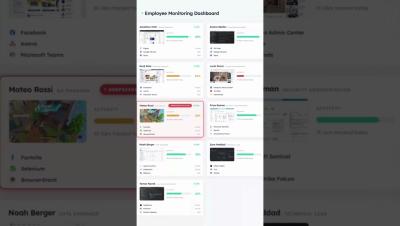
When people talk about mouse jiggler detection, they usually ask one question: how do you catch it? That is the wrong question. The better question is this: how do you know the activity you are seeing actually reflects real work? Mouse jigglers do not just simulate motion. They expose how fragile activity-based monitoring really is. If your system depends on cursor movement to define productivity, it can be gamed. The solution is not tighter surveillance, but better validation.

Powerful Ways Companies Monitor Remote Employees (Without Micromanaging)

The shift to remote and hybrid work has reshaped how companies manage performance, productivity, and collaboration. While employees enjoy flexibility, organizations often face challenges in ensuring accountability. There is a lack of balance in workloads, falling into the trap of constant micromanagement. Striking the right balance between trust and transparency has become the cornerstone of effective remote team management. That’s where remote employee monitoring comes in.

High-Performance Employee Behaviors Every Manager Must Track (To Spot Top Talent Fast)

The true measure of a high-performing employee goes beyond output. It lies in the behavior of employee patterns that consistently drive results. While metrics like deadlines and deliverables offer surface-level insights, it’s the underlying work behaviors and daily actions that reveal who your real top performers are. As per stats.

The 12 Best User Activity Monitoring (UAM) Tools in 2026

With employees using so many different devices and applications at work, it’s getting harder for companies to maintain visibility and control. User activity monitoring (UAM) software has emerged as a critical tool, empowering businesses to safeguard against data breaches, insider threats, and low productivity. This guide compares the top user activity and employee monitoring software solutions available today.

What Does Hybrid Remote Work Mean? The 2026 Guide Every Business Needs to Read

Work has changed, but many companies are still trying to define what that change actually looks like. Some teams are fully remote. Others are back in the office. But most businesses today are somewhere in between, trying to balance flexibility with productivity. That’s where the meaning of hybrid remote work becomes important. At a glance, hybrid work sounds simple. In reality, it’s one of the most misunderstood workplace models.

You Think Hiring Is Enough? Here's Why Workforce Planning Is Important in 2026

Hiring alone won’t future-proof your business, especially in a world shaped by AI, remote work, and constant disruption. In 2026, organizations need more than just talent acquisition; they need a clear strategy to ensure the right people, with the right skills, are in the right roles at the right time. That’s where workforce planning becomes a critical driver of growth, efficiency, and resilience.

Before You Offer Flexible Work, Know These 9 Critical Pros and Cons

Flexible work sounds like an obvious win. More freedom, happier employees, better productivity. That’s the promise. And in many cases, it’s true. But what most businesses miss is this: flexible work is not just a benefit. It’s a system. And if that system is not designed properly, it can create as many problems as it solves. In 2026, flexible work is no longer a perk. It’s an expectation.

How to Overcome Outsourced Call Center Challenges with Data

You outsourced your call center to reduce pressure, not to create new problems. But now, unfortunately, you’re dealing with multiple issues. CSAT complaints you can't trace, agents missing SLAs without control, and data you can't trust. This is the defining challenge of outsourced customer service: distance creates blind spots. The fix isn't micromanagement or in-house operation: it’s strategy backed with data.

The Role of AI and Automation in Call Center Trends

Call centers have never been pressured. Customers expect quicker responses, and agents feel more burned out. Similarly, U.S. companies still lose an estimated $75 billion annually from poor service. That’s why most businesses can’t help but adopt AI and automation in call centers. The global call center AI market is projected to reach $101.77 billion by 2034 at a CAGR of 17.76%. And 78% of organizations are already using AI in at least one business function.